Project Overview
Why the 2–6mm Range Is the “Wire Forming Sweet Spot”
If you’re sourcing a CNC wire bending machine, the first filter is diameter. Go below 2mm and you’re in spring coiler territory; go above 8–10mm and you’re into rebar benders / stirrup machines for construction — completely different buyer, different machine class.
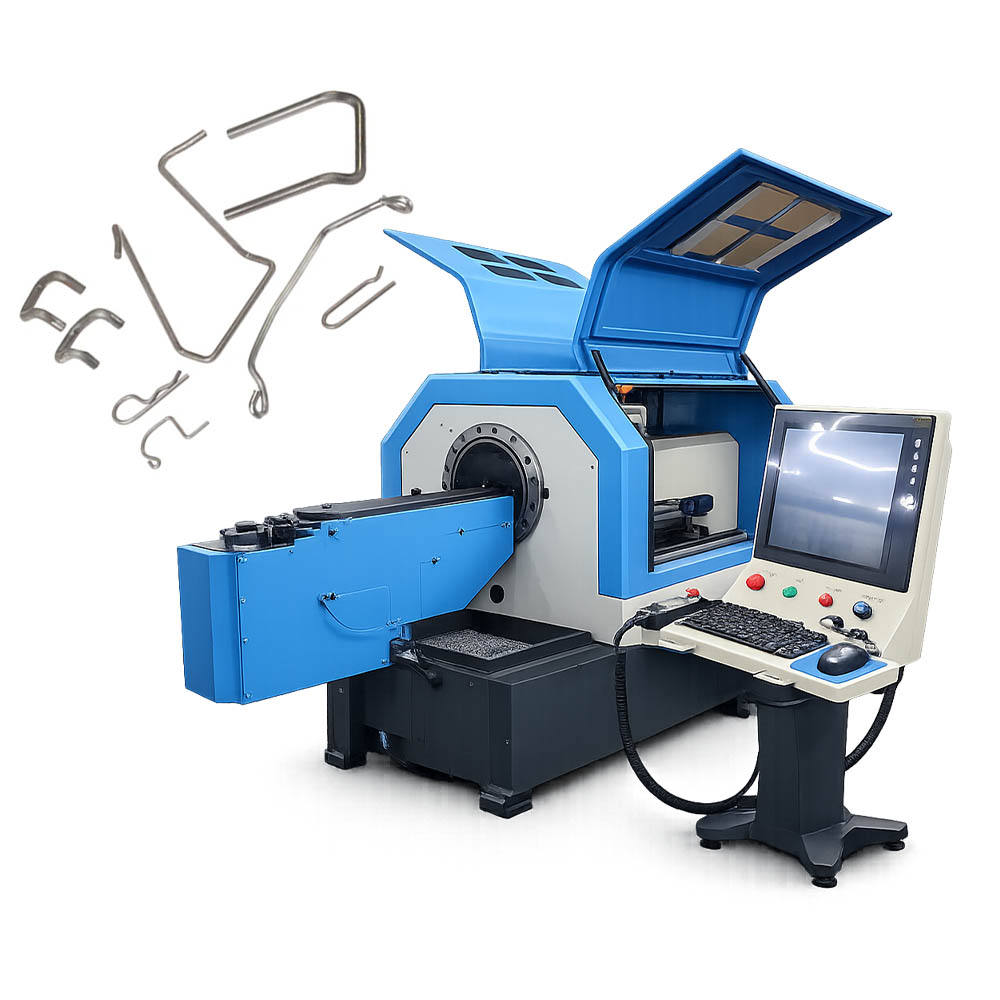
The 2–6mm steel wire band sits right in the middle, and it’s where high-volume, high-mix, precision wire forms live:
- Automotive Tier 2: exhaust hangers, seat frame wires, hood props, headrest insert wires
- Retail & Display: supermarket carts, slatwall hooks, display racks
- Household Appliances: fridge wire shelves, dish drainers, storage baskets
- Industrial hardware: custom clips, fasteners, cage frames
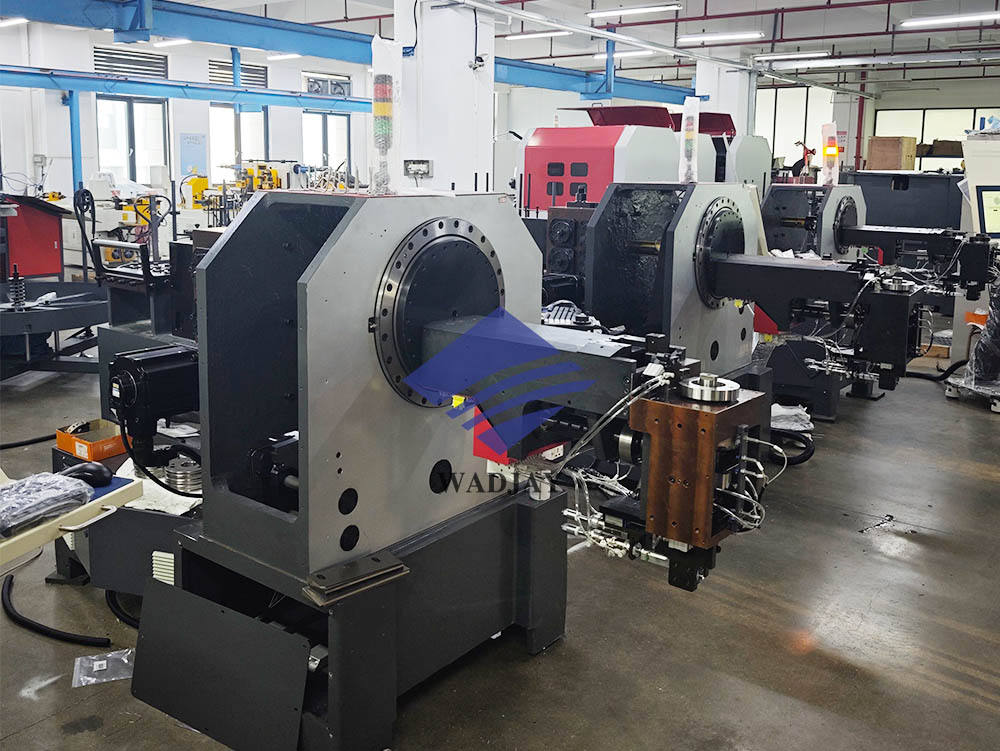
These parts share three traits: batch sizes in the thousands, profile complexity (2D + real 3D twists), and tolerance expectations that manual bending can’t hold. That’s exactly where the WADJAY 3D CNC Wire Bending Machine (2–6mm, 3/4/5-axis) lands — $10,000+ entry, servo-driven, ±0.1mm line feed / ±0.1° bend angle, up to 100 m/min feed speed, 1.5T footprint 230×110×170cm.
What “Multi-Servo” Actually Means on This Machine
Cheap wire benders use one main motor + mechanical cam/linkage to do “feed + rotate + bend.” They work for simple 2D shapes, but they fight two things:
- Cam changeover time — new part = new cam set = 2–4 hours
- Accuracy drift — linkage lash accumulates, especially on 3D profiles
The WADJAY 3D wire bender uses independent industrial servo motors per axis:
| Axis | What It Drives | Why Independent Servo Matters |
|---|---|---|
| Feed axis | High-torque servo roller feeding wire from decoiler | ±0.1mm linear feed precision, no slip, no surface scratch |
| Rotation axis | 360° rotational bending head around wire axis | “Twist-free 3D” — head rotates, wire stays axially stable |
| Bend axis | Bending arm / tool post | ±0.1° bend angle, repeatable batch-after-batch |
| (4th/5th axis) | Auxiliary bending / cut / additional head position | Complex 3D profiles in one cycle, no re-fixturing |
Result: you go from CAD/DXF → auto-program → first good piece in minutes, not hours. For shops running 20–30 SKUs per month (display hook lines, appliance basket variants), that changeover time is where the money is.
Production Flow – What the Machine Actually Does
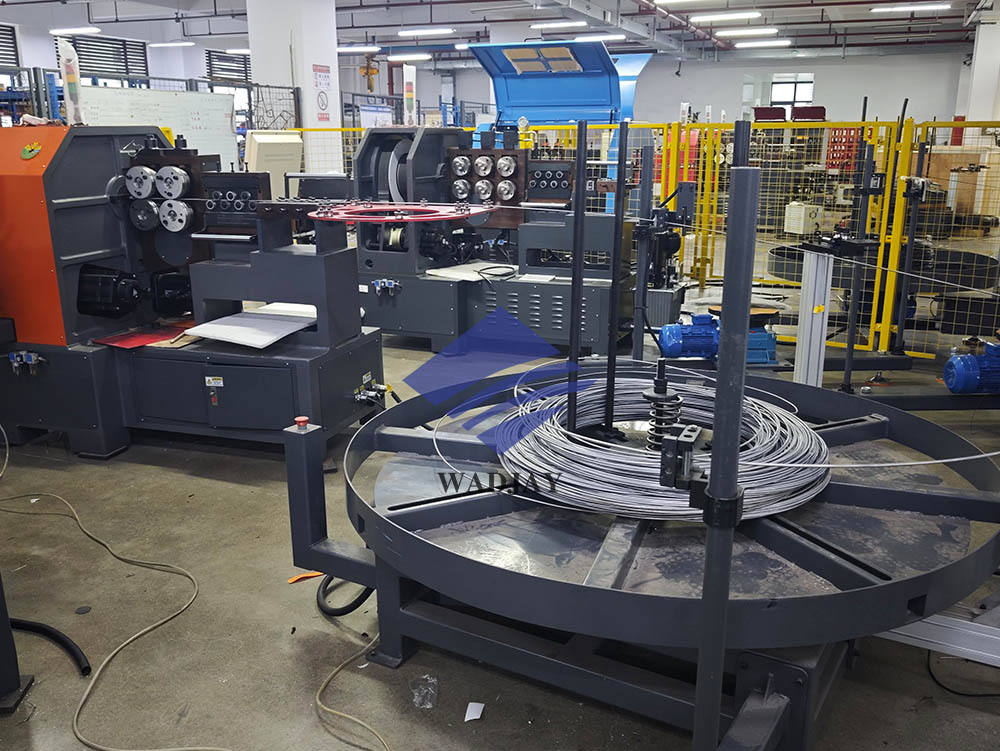
- Heavy-duty decoiler — raw wire coil (2–6mm, or custom up to 12mm) feeds in, tension-controlled
- Dual-line straightening unit — horizontal + vertical multi-roller straighteners eliminate wire memory and twist before forming (this is the step cheap single-line straighteners skip — and where “crooked parts” start)
- Servo feed — wire advances to length ±0.1mm
- 360° rotational bending head — rotates around wire axis, tooling bends the profile segment by segment
- Twist-free 3D forming — because the headrotates not the wire, the wire doesn’t torsion → structural integrity preserved, no “spring-back surprise” on complex 3D
- Automated cutting — burr-free cut at end of cycle (integrated shear/cutter in the head)
- Part drops → next cycle auto-starts
CAD/DXF Import + 3D Simulation = Green Hands in 2–3 Days
This is the quiet differentiator most suppliers’ brochures underplay.
The control platform:
- Direct CAD/DXF import — no “re-draw the part in machine language” step
- Automatic bending program generation — software converts the drawing into feed/bend/cut steps
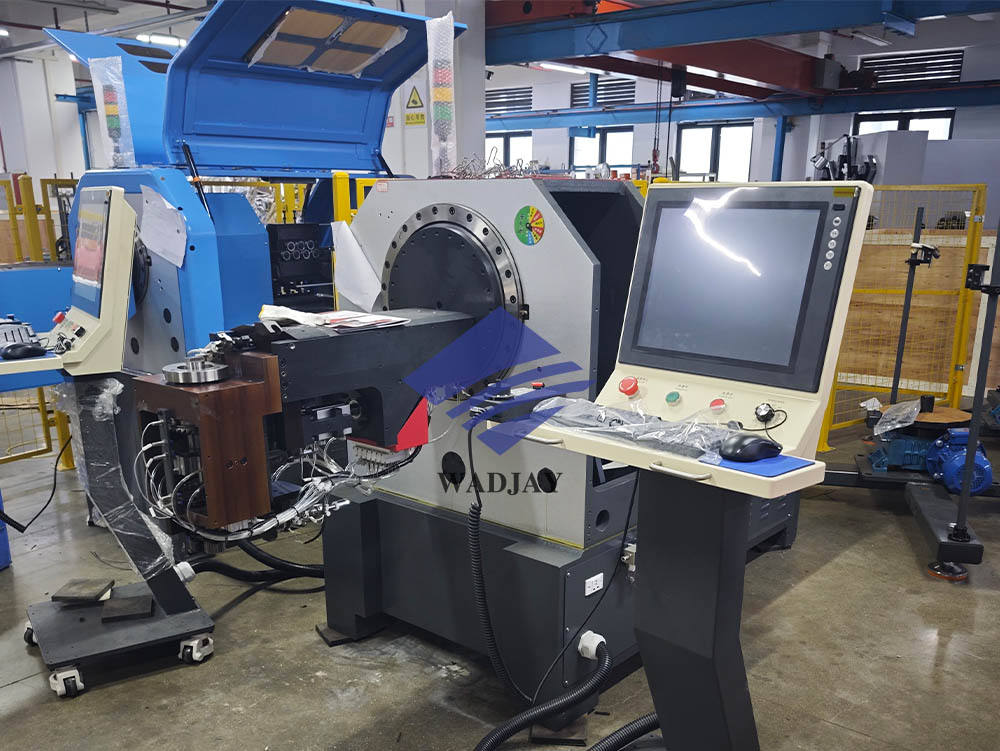
- Real-time 3D simulation — you see the part form on-screen before the first piece runs (catches wrong bend direction, wrong radius, collision with tooling)
- Touchscreen industrial CNC PLC — not a text-only terminal
WADJAY’s claim (and it aligns with what this machine class does): a new operator with no CNC background can be productive in 2–3 days. For small shops where “the old master bender retired” is a real risk, that matters.
3 Axis / 4 Axis / 5 Axis — How to Choose
Same base machine (decoiler + straightening + feed + head), different axis count for different part complexity:
| Config | What Extra Axes Add | Typical Parts |
|---|---|---|
| 3 Axis | Feed + Bend + Rotate (basic) | 2D shapes, simple 3D (exhaust hanger, basic cart wire, simple basket frame) |
| 4 Axis | + Auxiliary / cut or secondary bend | More complex 3D (shopping cart full frame, slatwall hook variants, seat wire with twist) |
| 5 Axis | + Second bending head position / more complex multi-plane | High-mix appliance baskets, automotive seat sub-frames, parts with 2+ bend planes in one cycle |
Full Technical Specifications
| Parameter | Value |
|---|---|
| Applicable Wire Diameter | 2.0 – 6.0 mm (customizable up to 12mm) |
| Control Axis | 3 / 4 / 5 Axis (model dependent) |
| Max Wire Feeding Speed | Up to 100 m/min |
| Linear Feeding Precision | ±0.1 mm |
| Bending Angle Precision | ±0.1° |
| Control System | Industrial CNC PLC + Touchscreen |
| Power Supply | 3-Phase 380V/50Hz (220V/440V 60Hz customizable) |
| Net Weight | ~1,500 kg (1.5 T) |
| Dimensions (L×W×H) | 230 × 110 × 170 cm |
Typical Parts & Why Wire Bender Beats Manual
🚗 Automotive Parts
- Exhaust hangers — 2–4mm wire, 6–9 bends, rubber bushing eyes — manual bender can’t hold ±0.1° batch-to-batch; wire bender does
- Car seat frame wires — 3D contours, multiple planes — 4/5 axis
- Hood props, headrest insert wires — small batches, high mix → CAD import payback
🛒 Retail & Display
- Supermarket shopping carts — full frame, 4–5mm, dozens of bends — one-cycle 4-axis
- Slatwall hooks — high volume, simple 2D/light 3D — 3-axis perfect
- Display racks — mix of straight + bent + twisted sections
🧊 Household Appliances
- Refrigerator wire shelves — 3–4mm, grid + rim bends — 3 or 4 axis
- Dish drainers, storage baskets — high volume, repeat pattern — 3-axis, 100 m/min feed = high throughput
🏭 Industrial / Hardware
- Custom clips, cage frames, guards — low volume, high mix → changeover time is the cost center, not cycle time
CNC Wire Bender vs Manual / Cam-Type Bender — Honest Split
| Factor | 3D CNC Wire Bending Machine (this) | Manual Bender / Jig | Cam-Type Auto Bender |
|---|---|---|---|
| Profile complexity | 2D + complex 3D | 2D simple only | 2D + limited 3D |
| Changeover | Minutes (CAD import) | Fixture rebuild = hours | Cam swap = 2–4 hrs |
| Accuracy | ±0.1mm / ±0.1° | Hand-dependent | ±0.2–0.5mm typical |
| Batch flexibility | High-mix OK | Low-mix only | Med-mix |
| Operator skill | 2–3 days training | Master bender needed | Mech. setup skill |
| Best fit | 2–6mm, high-mix, automotive/display/appliance | Prototypes, repairs | High-volume single-SKU |
Rule of thumb: if you have >5 SKUs per month or any 3D twist profiles, the CNC servo pays back. If you’re doing 10,000× of onesimple 2D clip — cam-type might still win on pure cycle. But most WADJAY buyers are in the “high-mix” bucket, not the “100k× one SKU” bucket.
Safety & Detection (Shop-Floor Reality)
- Wire jam sensor — stops machine if feed stalls (protects servo, protects tooling)
- Material exhaustion sensor — alerts before coil runs dry (avoids partial-part scrap)
- Operational deviation detection — if bend position / feed length drifts out of window, halt + alarm
On a 2–3 shift line, these sensors are what keep “unattended minutes” actually safe — not just a brochure checkbox.
Customization Options
- Wire diameter: 2–6mm standard; up to 12mm on custom spec (heavier servo/head)
- Axis count: 3 / 4 / 5 — priced accordingly
- Voltage: 380V/50Hz standard; 220V/440V 60Hz available
- Decoiler capacity: matched to wire coil weight (standard / heavy-duty expandable)
- Tooling: bend dies, cut blade, straightening rollers — custom per wire dia, included starter set
Operation & Maintenance Notes
- Straightening rollers: check/flip every 2–3 weeks on 2-shift; wire coating (if galvanized/painted) will wear roller profile — keep spares
- Servo parameters: feed accel/decel tuned to wire stiffness — 2mm soft wire ≠ 6mm spring wire; program stores per-SKU params
- Cut blade: burr-free claim depends on blade sharpness — scheduled replace every ~XXk bends (varies by wire grade; we give guideline in manual)
- Lubrication: guide bush / bend arm pivot — grease interval in manual; light oil on feed rollers if wire is dry
FAQ
Q: What’s the difference between “3 axis” and “4 axis” for 2–6mm wire?
A: 3 axis = feed + rotate + bend (covers most 2D and simple 3D like exhaust hangers, slatwall hooks). 4 axis adds an auxiliary function (second bend head position or cut/orbit), which lets you do more complex 3D — shopping cart frames, seat wires — in one cycle without re-fixturing. For most display + appliance shops, 4 axis is the “safe middle.”
Q: Can it handle stainless steel wire?
A: Yes — 2–6mm SS (304/316) is doable; tooling (bend die radius, cut blade) needs to match. Let us know if your run is SS-heavy; we adjust straightening roller hardness and bend die spec.
Q: What about galvanized / PVC-coated wire?
A: Galvanized is fine — straightening rollers are chosen to avoid coating tear (dual-line helps). PVC-coated needs slower feed + wider roller gap to avoid crush — we can preset parameters.
Q: How fast can a new operator learn it?
A: 2–3 days for basic operation (load program, run, change wire, basic troubleshooting). Programming from CAD/DXF is software-side — most shops have one “programmer” and 2–3 “operators,” not everyone needs to program.
Q: What file formats does it import?
A: CAD/DXF directly. Software auto-generates bending steps. You can also hand-enter coordinates if you prefer, but DXF import is where the time saving is.
Q: Can one machine do both 2mm and 6mm?
A: Yes — within the 2–6mm range. You swap straightening rollers and bend dies per diameter (quick-change). If you also need 8–12mm, tell us — we can custom-spec a head that covers wider range, or recommend two machines (2–6 + 8–12) if volume justifies.
Q: What’s the footprint and power?
A: 230×110×170cm, 1.5T, 3-phase. Fits a normal fabrication bay, no pit, no special foundation.
Q: What do you need to quote?
A: (1) Wire diameter range (2–6? up to 12?) — (2) Typical parts (send 2–3 drawings) — (3) Axis count preference — (4) Voltage — (5) Monthly volume per SKU (helps us suggest 3/4/5 axis).
-300x300.png)