Project Overview
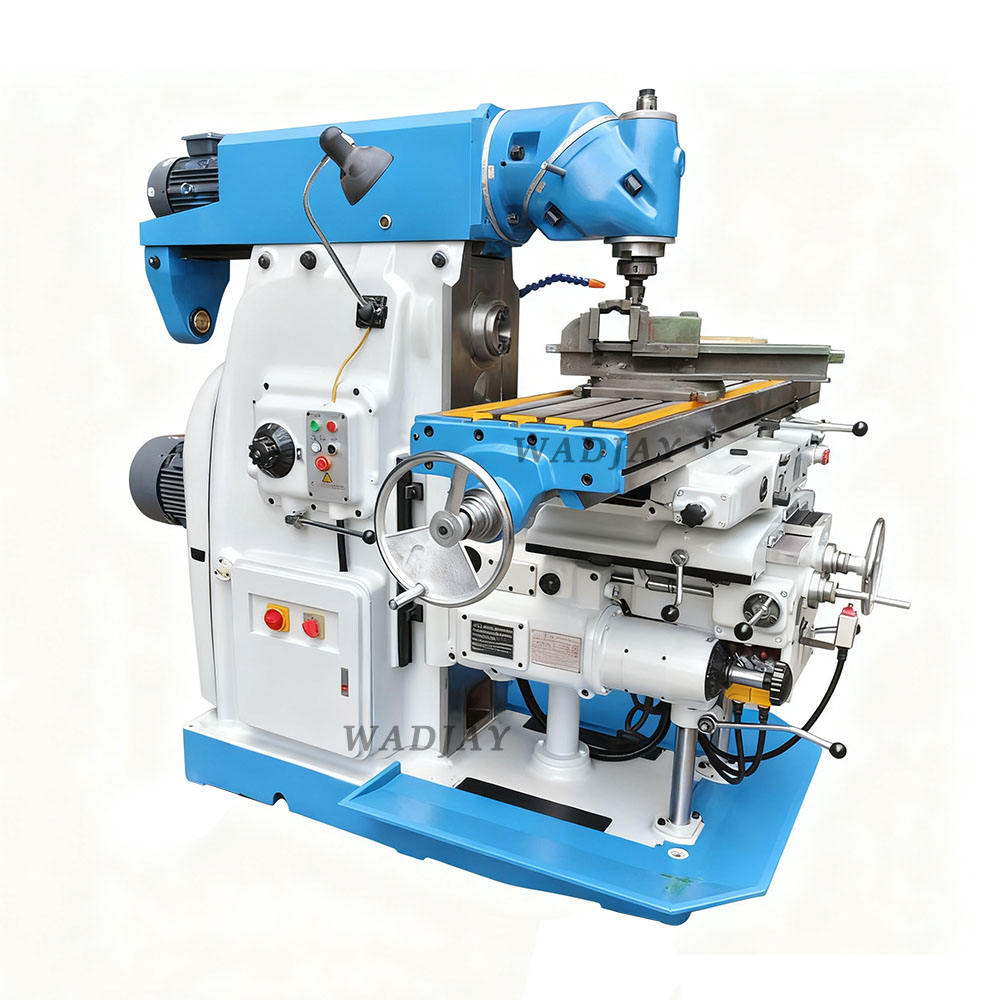
X6232 universal swivel head milling machine: 1320×320mm table, 700/280/350mm travel, 30-1500rpm 12-speed, ISO40, ≤0.02/300mm. Manual + DRO optional. CE/ISO.
Universal Swivel Head Milling Machine X6232 – Horizontal & Vertical Knee Mill for Tool Rooms & Repair Workshops
Why a Swivel Head Universal Mill Still Earns Its Floor Space
If you’re shopping universal milling machines, you’ve already ruled out two extremes:
- Machining centers — great for 3-axis production, but overkill (and over-cost) for one-off repairs, fixtures, and tool-room work
- Plain vertical knee mills — cheap, but can’t do horizontal milling or angle cuts without re-fixturing three times
The X6232 Universal Swivel Head Milling Machine sits between them: a heavy-duty knee-type universal mill with a 360° swiveling head that gives you vertical + horizontal + angular machining in one machine. That’s why it’s the default workhorse in tool rooms, repair workshops, maintenance departments, vocational training, and small-batch job shops — anywhere “flexibility per square meter” matters more than high-speed 3-axis production.
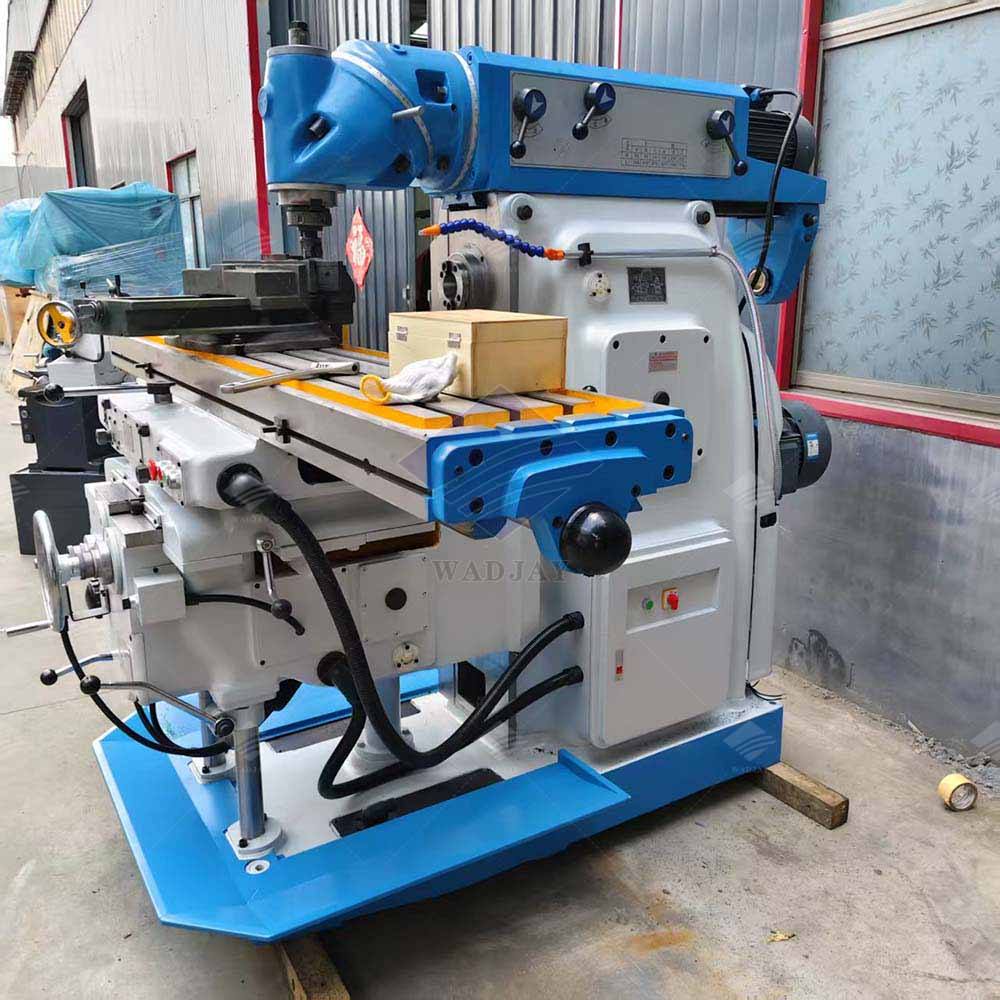
X6232 Technical Specifications (Hard Data)
| Parameter | Unit | X6232 Standard |
|---|---|---|
| Model | — | X6232 |
| Table Size | mm | 1320 × 320 |
| Longitudinal Travel (X) | mm | 700 |
| Cross Travel (Y) | mm | 280 |
| Vertical Travel (Z) | mm | 350 |
| Spindle Speed Range | rpm | 30 – 1500 (12-Speed, mechanical) |
| Main Motor Power | kW | 4 |
| Spindle Taper | — | ISO 40 |
| Control | — | Manual (Optional DRO) |
| Machining Accuracy | mm | ≤ 0.02 / 300 |
| Net Machine Weight | kg | 2200 |
| Power Supply | — | 3Ph 380V 50Hz (customizable) |
| Overall Dimensions (L×W×H) | mm | 2100 × 1700 × 1700 |
What “Swivel Head” Actually Buys You (vs Plain Vertical Mill)
A plain vertical knee mill locks the spindle vertical. To mill a horizontal feature (keyseat on a shaft, longitudinal slot on a block sidewall) or an angular face (dovetail, angled flange), you either:
- buy a separate horizontal mill, or
- re-fixture the part 2–3 times
The X6232’s 360° swivel head solves both:
- Vertical position → standard face milling, pocket milling, drilling/tapping (with quill feed)
- Horizontal position → mount horizontal arbor + slitting saw / side-and-face cutter / gear hob (small module)
- Intermediate angles → dovetails, angled mounting pads, compound-angle features without re-fixturing
That’s the definition of “universal” in this class — one machine, one setup, multiple orientation cuts.
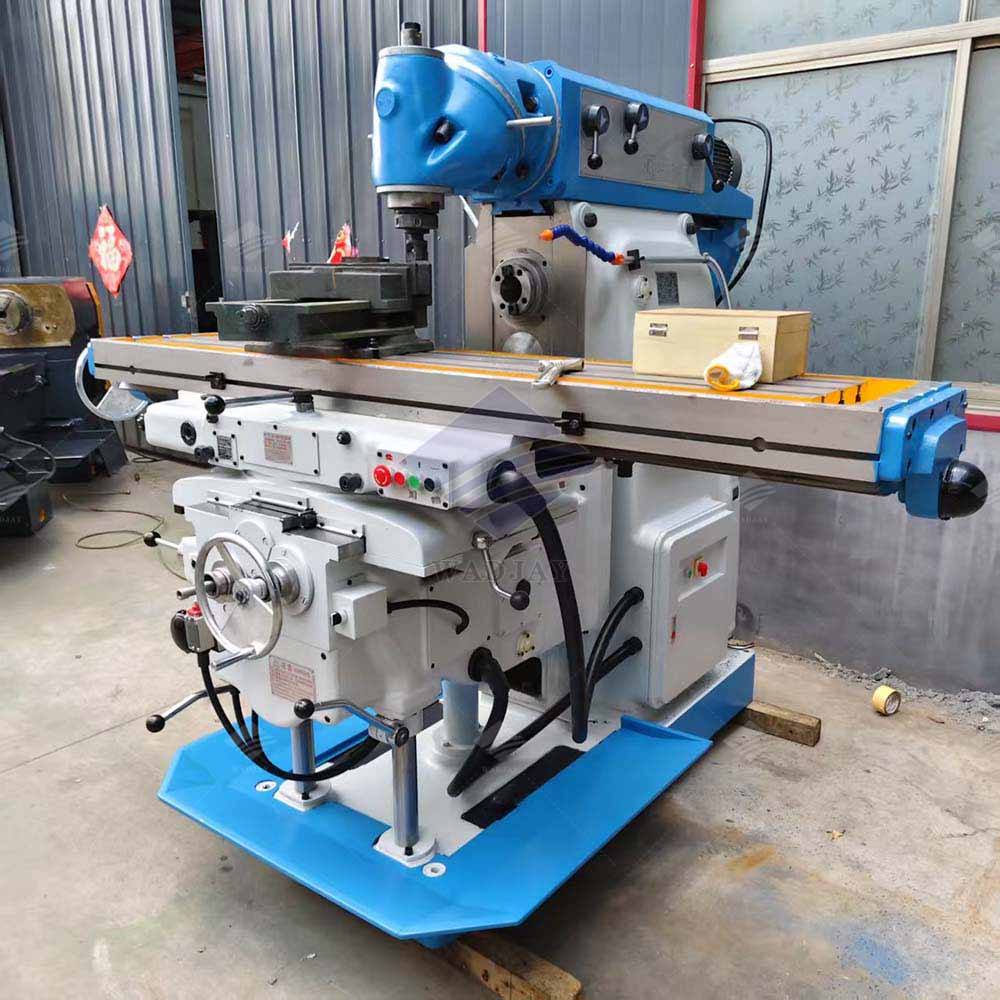
What “Swivel Head” Actually Buys You (vs Plain Vertical Mill)
A plain vertical knee mill locks the spindle vertical. To mill a horizontal feature (keyseat on a shaft, longitudinal slot on a block sidewall) or an angular face (dovetail, angled flange), you either:
- buy a separate horizontal mill, or
- re-fixture the part 2–3 times
The X6232’s 360° swivel head solves both:
- Vertical position → standard face milling, pocket milling, drilling/tapping (with quill feed)
- Horizontal position → mount horizontal arbor + slitting saw / side-and-face cutter / gear hob (small module)
- Intermediate angles → dovetails, angled mounting pads, compound-angle features without re-fixturing
That’s the definition of “universal” in this class — one machine, one setup, multiple orientation cuts.
Key Features (Brochure + Shop-Floor Reality)
✅ 1. 360° Swiveling Head = Vertical + Horizontal + Angular
The head swivels on two axes (typically tilt ±45° front-back, rotate 360° around column). Means:
- Vertical spindle work (face/pocket/drilling)
- Horizontal arbor work (slotting, slitting, side milling)
- Angled cuts (dovetail ways, angled mounting faces)
One machine replaces what otherwise needs a vertical + a horizontal.
✅ 2. Rigid Cast Iron Bed + Ground Guideways
2200kg in a 2.1×1.7×1.7m footprint — mass is where it matters:
- Vibration dampening during interrupted cuts (slotting, gear cutting form tools)
- Surface finish → Ra ≤ 1.6µm achievable with sharp tooling & proper speed/feed
- Tool life → less chatter = longer edge life, especially on HSS form tools (gear cutters, dovetail mills)
✅ 3. 12-Speed Mechanical Range (30–1500rpm)
Mechanical step pulleys/gears, not VFD-only:
- 30–75rpm → large face mill on steel, heavy stock removal
- 118–300rpm → side milling, slab milling
- 475–1500rpm → endmills, slot drills, small form tools
- No “electronics-only” failure path — mechanical drive trains are field-repairable in markets where CNC service isn’t around the corner
✅ 4. ISO40 Spindle Taper — Tooling Ecosystem
ISO40 (BT40 / SK40 compatible holders) is:
- Global standard — collets, endmill holders, shell mill arbors, horizontal arbor supports all off-the-shelf
- R8 alternative avoided — ISO40 is the “real shop” standard outside North American school shops; if you’re exporting, ISO40 is the right call
- Quill feed on the head for drilling/tapping cycles (manual, but controlled)
✅ 5. Optional DRO (Digital Readout)
Manual control is baseline; 2-axis or 3-axis DRO optional:
- Position readout on X/Y (Z optional) → faster setup, fewer test cuts
- Reduces operator skill dependency — important in markets where master machinists are scarce
- Still a manual machine — no G-code, no CAM, just handwheel + DRO digits
✅ 6. Tool Room & Repair Workflow Fit
Designed for:
- Fixtures / jigs / templates — low-qty, high-precision
- Repair parts — one-off bearing housing face, keyseat repair, flange resurfacing
- Prototypes — before committing to CNC program
- Training — vocational / technical institutes teaching fundamentals
✅ 7. Global Export Ready
- CE / ISO certified
- Customizable voltage (380V/50, 415V/50, 440V/60…)
- Complete export docs, crating, layout drawing, manual (EN)
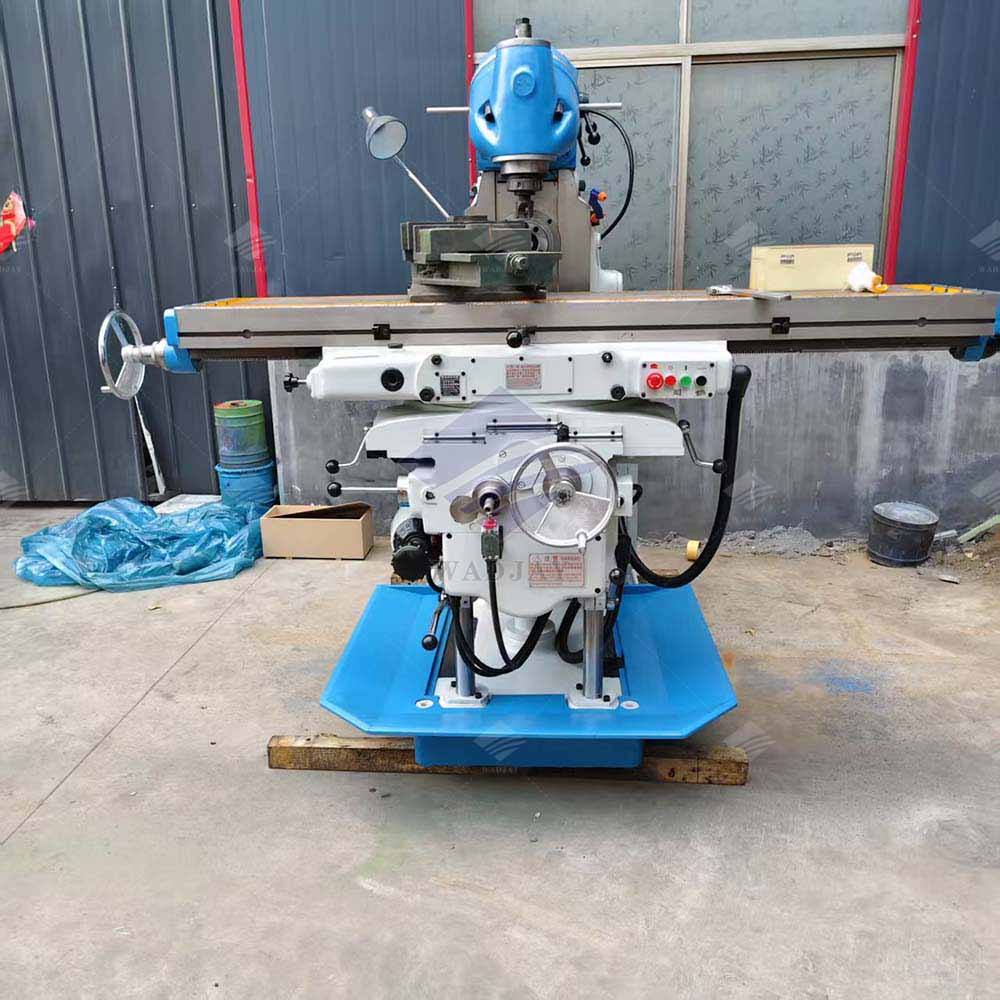
What the X6232 Machines Well (Application List)
| Part / Task | Why X6232 Fits |
|---|---|
| Flat surfaces / slabs | Face mill on cast iron / steel plates, machine bases |
| Slots & keyseats | Horizontal arbor + slitting saw; also vertical endmill slotting |
| Dovetails (machine ways, jig slides) | Swivel head to dovetail angle, single setup |
| Simple gears / splines (low module) | Horizontal arbor + indexing head (optional accessory) |
| Drilling / tapping (manual) | Quill feed on vertical spindle, DRO helps hole pattern |
| Angular mounting pads / flanges | Head swivel = no re-fixturing |
| Fixture / jig plates | Manual + DRO = cost-effective low-qty precision |
| Repair & maintenance parts | One-off bearing housing face, pump flange resurfacing |
⚠️ What it’s NOT: it’s not a production 3-axis CNC. If your core business is 50-piece+ batches of prismatic parts, buy a VMC. The X6232 is for the rest — the 1-off, the repair, the fixture, the training, the “CNC can’t justify” jobs.
X6323 vs A “VMC” — Honest Buying Split
| Factor | X6232 Universal Swivel Head Mill | VMC (Machining Center) |
|---|---|---|
| Batch size | 1-off, low-qty, repair, fixture | 10–50+ repetitive |
| Setup | Manual handwheel (+ DRO) | Program + probe |
| Operator skill | Machinist fundamentals | CNC programmer / operator |
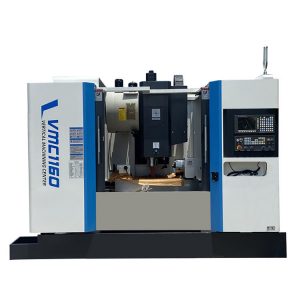
| Spindle orientations | Vertical + horizontal + angular | Vertical only (unless 5-axis) |
| Price point | Fraction of VMC | 3–10× |
| Best fit | Tool room, repair, training, job-shop misc | Production prismatic parts |
Rule of thumb: if >60% of your work is “one-offs, repair, fixtures, training,” the X6232 earns its keep. If >60% is repeat batch prismatic, go VMC. Most mixed shops keep one universal mill + one or two VMCs — they don’t replace each other.
Typical Buyer Profiles (Who Actually Orders X6232)
- Tool rooms in automotive/machinery plants — fixtures, jig plates, repair parts
- Repair workshops — pump/gearbox/motor repair, keyseat rework, flange facing
- Vocational / technical institutes — teaching milling fundamentals, ISO40 tooling ecosystem
- Small job shops — miscellaneous one-offs between CNC batches
- Maintenance depts — captive plant maintenance (cement, sugar, textile, paper mills)
- Government workshops / ordnance depots — multi-role, low-electronics, repairable in-field
Optional Accessories (What You’ll Usually Add)
- Indexing head (dividing head) — for gears, splines, fluted cutters, polygonal parts
- Horizontal arbor & supports — slitting saws, side-and-face cutters
- Rotary table (vertical) — circular features, hole patterns on arcs
- DRO (2-axis or 3-axis) — X/Y standard, Z optional
- Coolant pump & tray — flood coolant for steel/CI
- Vise, clamps, stud kit — workholding starter set
- ISO40 tooling package — collets (ER32 or SK40), endmill holders, shell mill arbors, face mill
Operation & Maintenance – Shop-Floor Notes
- Lubrication: manual oil cups on slides + centralized lube on saddle (check weekly in 2-shift)
- Guideways: keep chips off ground ways; wipe & re-oil daily — ground CI ways will hold accuracy years if cleaned
- Spindle: ISO40 taper — blow clean before every holder mount; drawbar torque to spec
- Speed selection: use low range (30–300) for face mills >80mm Ø or heavy stock; high range (475–1500) for endmills ≤16mm
- Accuracy check: dial indicator on table/X/Y/Z every 6–12 months if machine is in daily use; ≤0.02/300 is the design target, holds if guideways cared for
FAQ
Q: What’s the difference between “universal swivel head milling machine” and a “plain vertical knee mill”?
A: A plain vertical knee mill locks the spindle vertical only. A universal swivel head mill (like X6232) can swing the head to horizontal and to intermediate angles, so you get vertical + horizontal + angular milling in one machine without re-fixturing.
Q: Does the X6232 come with DRO as standard?
A: No — base machine is manual handwheel control. DRO is optional (2-axis or 3-axis). For tool rooms and training shops, we recommend DRO — it speeds setup and reduces operator dependency.
Q: Can it cut gears?
A: Simple spur gears / splines at low module (M2–M4 range, depending on arbor/cutter) — yes, with a horizontal arbor + indexing head. It’s not a gear hobber (YK-series is for that), but for occasional gear repair in a maintenance shop, it covers.
Q: What’s the spindle taper? Can I use BT40 / SK40 tooling?
A: Spindle is ISO40, which is compatible with standard BT40 / SK40 holders, collets, shell mill arbors, and horizontal arbor supports. Tooling is globally available.
Q: How does it compare to a machining center?
A: It’s manual (DRO optional), not CNC. No G-code, no ATC, no high-speed 3-axis production. It’s for one-offs, repair, fixtures, training — the work a VMC can’t justify program time for. Most mixed shops keep both.
Q: What power and space does it need?
A: 3-phase (380V/50Hz standard, customizable). Footprint 2100×1700×1700mm, 2200kg net. Reinforced concrete pad, no pit. Fits a normal tool-room bay.
Q: What info do you need to quote?
A: (1) DRO yes/no + axes — (2) Accessories needed (indexing head, rotary table, arbor kit) — (3) Tooling package? — (4) Voltage — (5) Approx use case (tool room / repair / training).