.png)
Project Overview
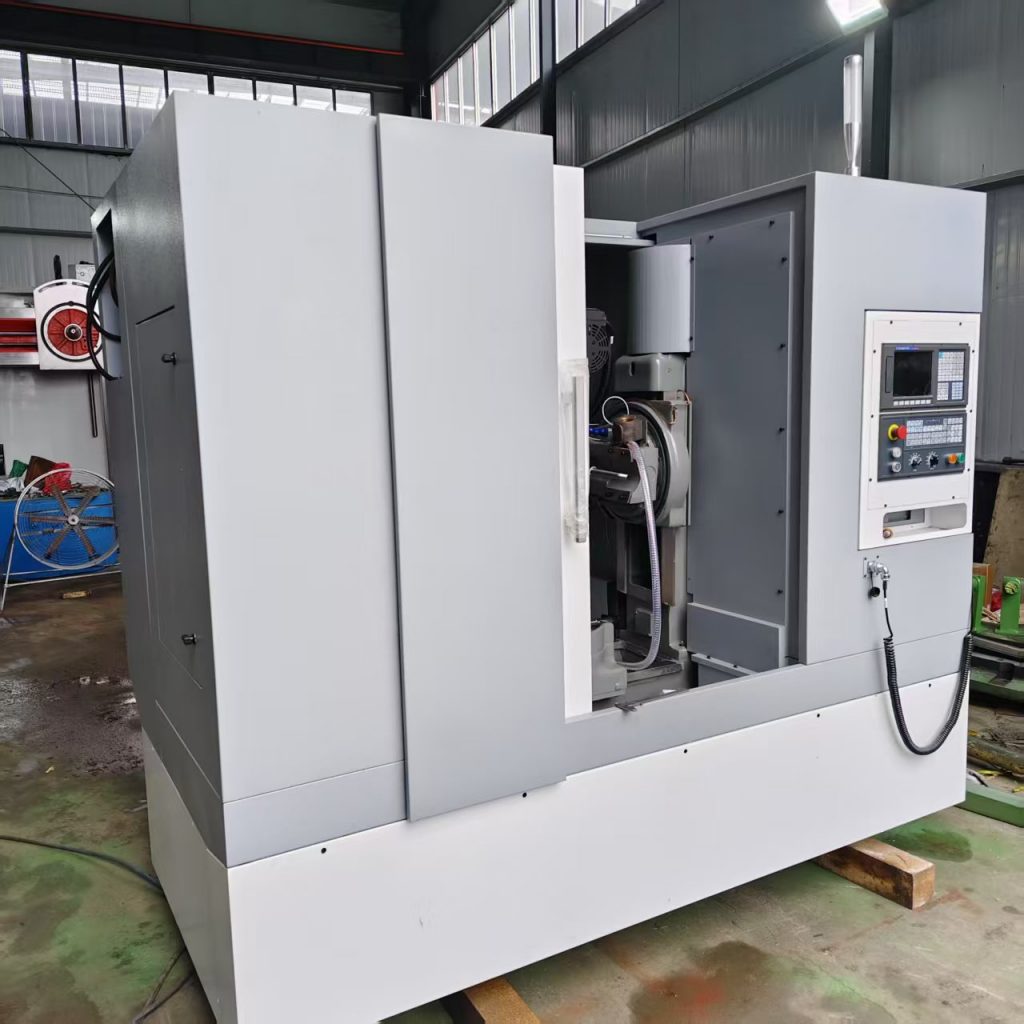
YK5132 CNC gear shaping machine, max Ø320mm, M6, 4-axis CNC linkage, GB/T 6-7 accuracy. Fully enclosed design with safety interlock. Siemens/Fanuc optional. Factory direct.CE/ISO certification
Why the 320mm Class Is the “Sweet Spot” for CNC Gear Shaping
If you’re sourcing a CNC gear shaping machine, the first question isn’t “how big” — it’s “what size actually matches my parts.”
Go too small (Ø160–200mm class), and you’re fighting for floor space with bench-type shavers that can’t hold heavy blanks. Go too big (Ø800–1250mm, like our Y51125), and you’re over-built for the parts that dominate automotive transmissions, aerospace accessory drives, RV reducer internals, steering systems, and industrial pump gears — all of which cluster in the Ø120–320mm, M3–M6 range.
The YK5132CNC sits exactly in that sweet spot:
- Max external / internal gear Ø: 320mm
- Max module: 6
- Max workpiece height: 250mm
- Ram stroke: up to 100mm
- Strokes/min: 20–150 stepless (CNC-variable, not mechanical step pulley)
That spec window covers the majority of serial-production gear blanks where “internal teeth + shoulder clearance + batch repeatability” matters more than raw diameter. And because this version is fully enclosed — safety-door interlocks, coolant-mist containment, noise suppression — it’s aimed at modern automotive & aerospace job shops where ISO audit, oil fog, and operator ergonomics are part of the buying checklist, not nice-to-haves.
YK5132CNC Technical Specifications
| Parameter | Unit | YK5132CNC (Standard) |
|---|---|---|
| Model | — | YK5132CNC |
| Max. External Gear Diameter | mm | 320 |
| Max. Internal Gear Diameter | mm | 320 |
| Max. Machining Module | mm | 6 |
| Max. Workpiece Height | mm | 250 |
| Max. Ram Stroke Length | mm | 100 |
| Ram Stroke Speed | strokes/min | 20–150 (Stepless, CNC) |
| Main Motor Power | kW | 5.5 |
| Control System | — | CNC (Siemens / Fanuc / GDS optional) |
| Machining Accuracy | — | GB/T 6–7 |
| Axes | — | 4-axis CNC linkage |
| Net Machine Weight | kg | ≈4,500 |
| Power Supply | — | 3Ph 380V/400V 50Hz (customizable) |
| Overall Dimensions (L×W×H) | mm | 2200 × 1600 × 2200 |
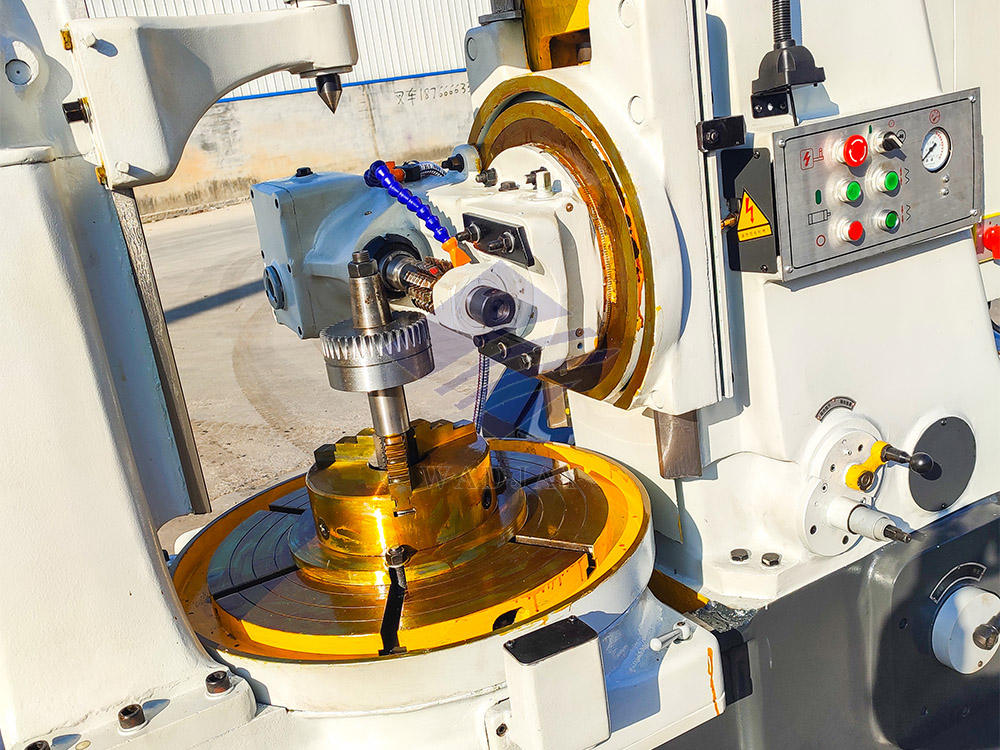
Gear Shaping vs Gear Hobbing – When You Actually Need a Shaper
This is the single most searched comparison in the category, so let’s be honest about it.
| Factor | CNC Gear Shaping Machine (YK5132CNC) | CNC Gear Hobbing Machine (e.g. YK3180CNC4) |
|---|---|---|
| Internal gears / ring gears | ✅ Native | ❌ Not feasible |
| Shouldered blanks / double-gear clusters | ✅ Cutter clears shoulder | ⚠️ Hob diameter may foul |
| Max practical module (this size) | M6 (320mm class) | M8–M10+ easily |
| Max Ø (this class) | 320mm | 800–1000mm+ |
| Profile flexibility (non-involute, specials) | ✅ Shaper cutter can be profiled | Limited |
| Typical accuracy ceiling | GB/T 6–7 | GB/T 6 (with grinding follow-up GB/T 4–5) |
| Best fit | Internal + external, shoulder-conflict parts, M≤6 | External only, higher module, larger Ø |
Rule of thumb: if your part has any internal teeth, or sits on a shoulder where a hob can’t clear, the conversation ends at “shaper.” If your part is external-only, M8+, Ø>320mm — go hobber. We stock both lines, so we’re not pushing you wrong.
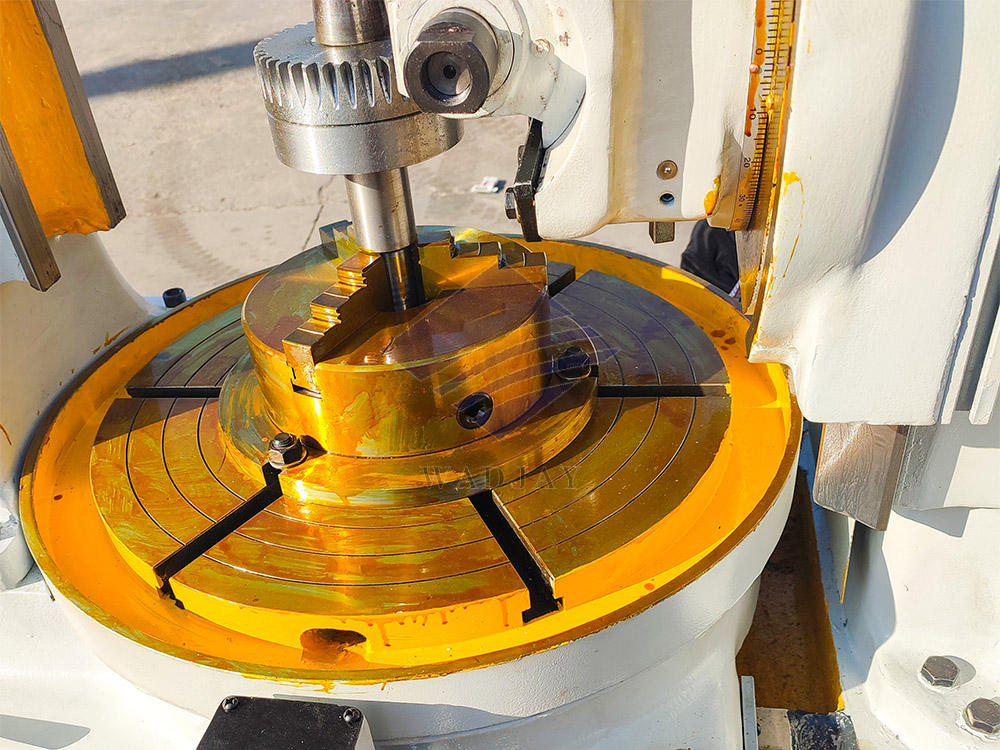
What “Fully Enclosed” Really Buys You (Beyond the Brochure)
A lot of YK5132-class machines on the market are open-frame with splash guards — fine for old-school job shops, but a problem for two buyer types:
- Automotive Tier suppliers & aerospace subcontractors — ISO 45001 / 14001 audits, oil mist limits, guarded-moving-part rules
- Mixed-line workshops — the shaper sits next to a CMM, a VMC, or an assembly bench; you can’t have oil fog drifting 10 meters
The YK5132CNC enclosure solves three things at once:
- Safety door interlocks — ram and table won’t move with the door open. Moving reciprocating ram + rotating table = real pinch/entanglement risk; interlocks close that.
- Coolant mist containment — oil-mist extraction can be tied into the shop system; the cabin keeps it from becoming “general ventilation” load.
- Noise reduction — reciprocating cut at 80–120 strokes/min is audible; the panel + gasket set drops shop-floor dB, which matters on 2–3 shift lines.
For export markets (EU especially), “fully enclosed + interlocked” is often the difference between “quote accepted” and “safety audit rejected.”
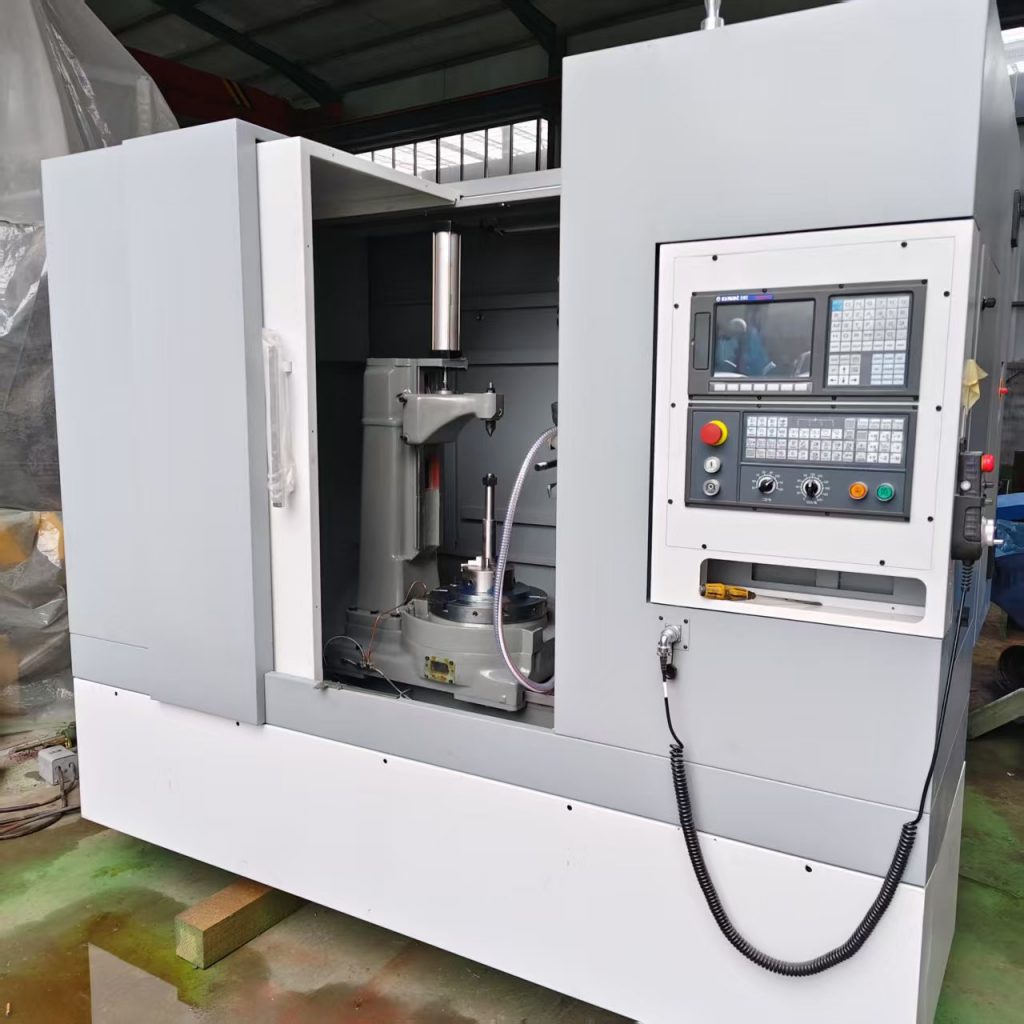
4-Axis CNC Linkage – What It Changes on Tooth Quality
Mechanical Y51/YK5132B machines rely on change gears for index and feed. They work, but they introduce:
- Change-gear lash (especially after 12–18 months)
- Setup time (operator digging through a gear tree)
- Batch-to-batch drift when the same machine runs M3 Monday, M5 Wednesday
The YK5132CNC runs 4-axis CNC linkage:
- C-axis (table rotation) → closed-loop indexing, tooth-spacing consistency
- X-axis (radial infeed) → programmable infeed/mm or per-stroke, including rough/finish split
- Z-axis (ram position / stroke phase) → top-position set digitally, not feeler-gauge
- Spindle (cutter RPM) → servo-controlled, matched to stroke speed
Result: GB/T 6–7 that holds across the batch, not just the first piece. For automotive Tier suppliers running PPAP-level documentation, that repeatability is what gets you through the gate.
Rigid Structure & Linear Guides – Why the Accuracy Sticks
Gear shaping is an interrupted, reciprocating cut — the tool hits, stops direction, hits again. That’s fundamentally harder on the structure than hobbing’s continuous roll.
YK5132CNC’s answers:
- High-ribbed cast iron bed — damp vibration, hold geometry under load
- Precision linear guides (ram guidance + table ways) — repeatable axis motion, less stick-slip than scraped box ways on light cuts
- 5.5 kW main motor — enough headroom for M6 roughing in 250mm face without bogging
- 4,500 kg net weight in a 2200×1600 footprint — mass where it matters
The practical payoff: longer cutter life, better flank finish, less “first-piece / last-piece” drift in a 200-piece batch.
Typical Workpieces the YK5132CNC Machines
🚗 Automotive Transmission
- Input / countershaft gears (external, but shoulder on one side → shaper clears better than hob)
- Reverse idler clusters (double-gear blank, internal + external on same hub)
- Differential side gear internals (small ring, M4–M5, shoulder-clearance critical)
✈️ Aerospace Accessory Drives
- Auxiliary pump drive gears (small ring sets, tight tolerance, low volume → CNC shaper beats a hob line on setup time)
- Actuation system pinions (M3–M4, thin-wall, shoulder conflict)
🤖 Robotics / RV Reducers
- RV internal ring gears (M4–M5, Ø180–280mm class, GB/T 6 wanted)
- Cycloidal disk indexing holes (sometimes shaped if profile allows, though broaching/EDM also competes — shaper wins on small batches)
🏗️ Industrial & Agricultural
- Pump gerotor rings (internal inviolute or modified profile)
- Steering column small gears
- Agricultural reducer planet gears (M5–M6, cluster blanks)
Application Industries (Short Expansion)
- Automotive & Commercial Vehicle – transmission, steering, differential, aux drives
- Aerospace & Defense – accessory gearboxes, actuation, small ring sets
- Industrial Robotics – RV reducers, joint drives
- Industrial Gearboxes – pump, compressor, conveyor drives
- Agricultural & Construction Machinery – reducer internals, PTO accessories
Tooling & Workholding – The Stuff Brochures Skip
A shaper is only as good as the cutter + holder + workholder triangle.
- Cutter interface: standard 88.9mm / 101.6mm taper-bore shank (industry-common). We can source or advise on tooth count, profile shift, and material (HSS, powder HSS, coated) based on your module and workpiece material (40Cr, 20CrMnTi, 42CrMo, cast iron).
- Radial runout: keeper at ≤0.01mm on the cutter seat if you want GB/T 6 consistently.
- Workholding: 3-jaw chuck, diaphragm chuck, or custom fixture on the Ø320-class table. Coaxiality between ID/OD and table center is half your tooth-flank result — we can review your blank drawing and suggest fixture approach.
- Cutter relieving: the YK5132CNC’s ram gives ≥0.65mm oscillating relief on return (machine-class standard), protecting flank and extending edge life.
Operation, Maintenance & Shopfloor Tips
- Stroke speed selection: 20–80 strokes/min for M5–M6 roughing (stable cutting, tool life); 100–150 for M3–M4 finishing / short-face parts. “Stepless” means you don’t jump from 63→80→100 in fixed steps — you dial what the cutter actually wants.
- Coolant: oil-based (not emulsion) for most gear shaping — the enclosed cabin + mist extraction pair with that. Tank, filter, and nozzle are part of the standard package.
- Guide & lubrication checks: linear guides on ram and table — grease interval ~3 months under 2-shift; log it, your GB/T 6 will hold longer.
- Accuracy re-check: after ~6 months of production, check tooth-spacing and profile on a first-piece from a fresh batch. If you see drift, it’s usually cutter wear or workholder repeatability, not the machine.
YK5132CNC vs Y51125 vs YK3180CNC4 – Quick Selection
| If your parts are… | Go with… |
|---|---|
| Ø≤320mm, M≤6, internal teeth / shoulder clusters | YK5132CNC (this page) |
| Ø up to 1250mm, M12, heavy mining/wind | Y51125 (larger class shaper) |
| External only, M≥6, Ø≥320mm, no internal | YK3180CNC4 (hobber) |
📌 这一段是 silo 内链的主锚——三台机器互相指,Google 会把 wadjay.com 认成 “gear cutting equipment” 专题站而不是单页农贸。
FAQ
Q: Can the YK5132CNC cut helical gears?
A: External helical gears yes — with a spiral (helical) guideway attachment, typical angles up to ~23°15′ for this class. Internal helicals are limited and should be evaluated case-by-case with your drawing.
Q: What accuracy can I expect?
A: Rated GB/T 6–7. For GB/T 5–4 (premium automotive / aerospace), plan a shape + grind route — the shaper makes the near-net shape, the grinder closes the last 2–3 grades.
Q: What control systems are available?
A: Standard quote includes GDS (cost-effective, widely supported in CN export market); Siemens and Fanuc optional if your plant already runs those ecosystems (spare parts, programmer familiarity).
Q: What’s the footprint and foundation need?
A: 2200×1600×2200mm, ~4,500 kg. Reinforced concrete pad, tie-downs; no pit required. Fits most VMC-level shop floors.
Q: How does “fully enclosed” affect chip/coolant handling?
A: Chips drop into the base tank; coolant is pumped, filtered, re-circulated. Enclosure keeps mist in, so you can tie it to a shop-wide oil-mist extractor if needed.
Q: What info do you need to quote?
A: Gear drawing (OD/ID/M/face/material) + batch size + your voltage/standard + preferred CNC (Siemens/Fanuc/GDS). We return layout drawing + config + price + lead time.