
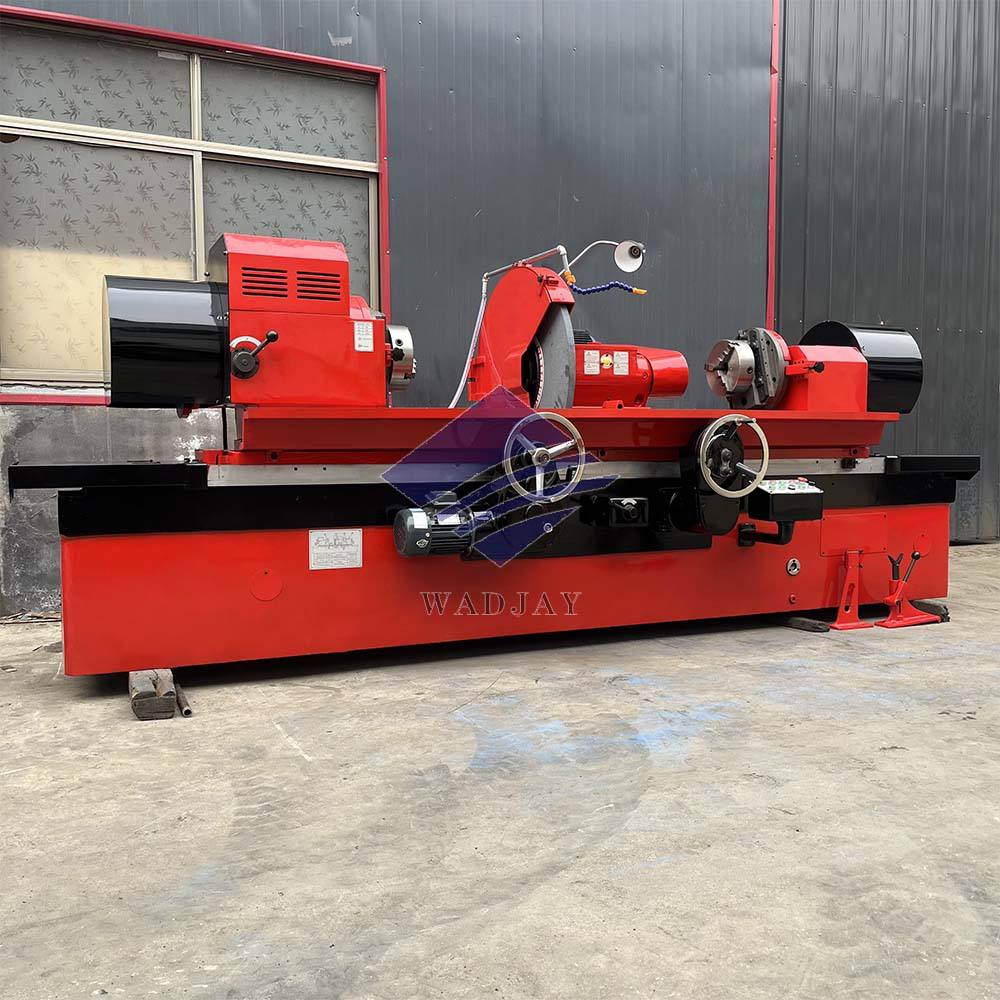
Project Overview
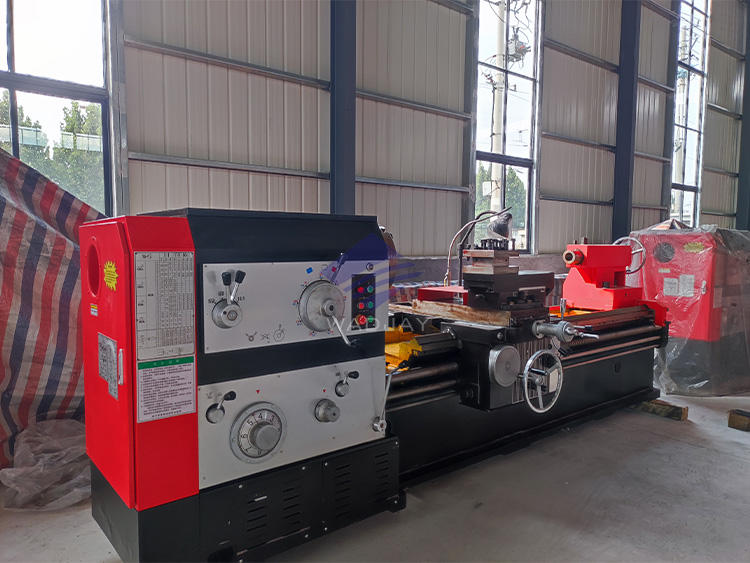
CW6180 heavy duty horizontal lathe, max swing 800mm, bed length 1500–3000mm customizable. 11/15kW, 12-speed 10–1000rpm, cast iron bed. For shaft, pipe, flange.
CW6180 Heavy Duty Horizontal Lathe – 800mm Swing Conventional Lathe for Shafts, Pipes & Flanges
Why an 800mm Heavy-Duty Horizontal Lathe Still Has a Place Beside CNC
If you’re shopping heavy duty horizontal lathes, the first fork in the road is: CNC slant-bed vs conventional flat-bed.
CNC lathes win on repeat batch prismatic + tight tolerance + complex contour. But for a whole class of work — long shafts, heavy-wall pipes, large flanges, roller bodies, mandrels — three things matter more than G-code:
- Swing capacity & bed length — can the workpiece even sit on the machine
- Rigid casting + spindle torque — can you take a heavy roughing cut without deflection
- Simplicity & on-site repairability — mechanical drive you can fix in a repair shop, not just at the OEM desk
The CW6180 (C6180) heavy-duty horizontal lathe is built exactly for that: max swing over bed 800mm, bed lengths 1500 / 2000 / 3000mm (customizable), 11/15kW main motor, 12-speed mechanical spindle (10–1000rpm), thick cast iron bed, manual (mechanical) control. It’s the machine that lives in heavy machinery plants, oil & gas equipment shops, power equipment workshops, and repair / maintenance bays — anywhere “large, heavy, low-mix” turning is the daily bread.
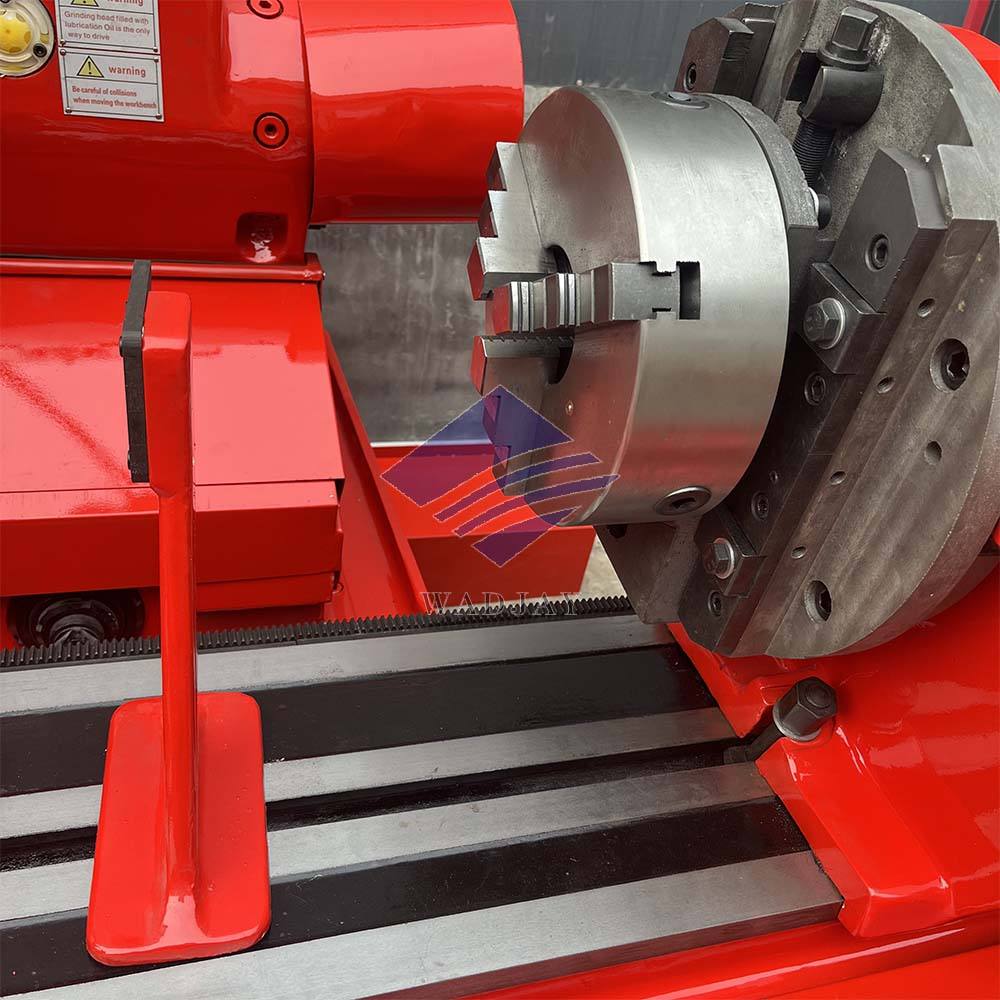
CW6180 Full Technical Specifications
| Parameter | Unit | CW6180 Standard |
|---|---|---|
| Model | — | CW6180 (C6180) |
| Max. Swing Over Bed | mm | 800 |
| Max. Workpiece Length | mm | 1500 / 2000 / 3000 (customizable) |
| Spindle Speed Range | rpm | 10 – 1000 (12-Speed, mechanical) |
| Main Motor Power | kW | 11 / 15 |
| Max. Cross Slide Travel | mm | 420 |
| Tailstock Quill Travel | mm | 300 |
| Control System | — | Manual (Mechanical) |
| Net Machine Weight | kg | 5500 / 6500 / 7500 (by bed length) |
| Power Supply | — | 3-Phase 380V 50Hz (customizable) |
| Overall Dimensions (L×W×H) | mm | 3500×1600×1600 (1500 bed) up to 6500×1600×1600 (3000 bed) |
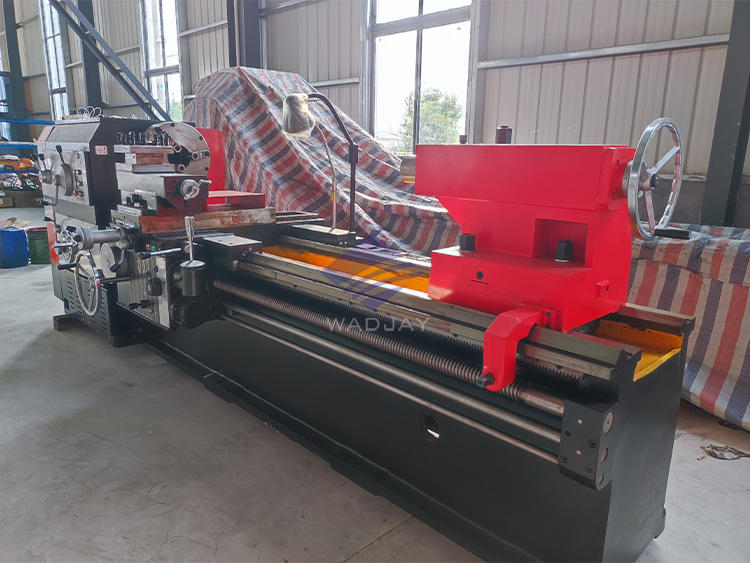
Why “800mm Swing / 3000mm Bed” Is the Heavy-Lathe Sweet Spot
If you map heavy lathe demand by swing:
- ≤ 500mm → standard universal lathe (CA6140 class), overflow with CNC now
- 630–800mm → the “still fits a normal bay, but handles real heavy shafts” band
- ≥ 1000mm → roll lathe / faceplate lathe territory, footprint & crane requirement jump
The CW6180 sits at 800mm — large enough for:
- Shafts: Ø120–300mm, L 1500–3000mm (reducer input/output, pump shaft, fan shaft)
- Pipes: heavy-wall Ø200–600mm (oil & gas line spools, casing adapters)
- Flanges: up to 800mm OD (blind / weld-neck / slip-on, facing + boring + drill-tap)
- Roll bodies / mandrels: small-to-mid rolling mill rolls, calendar rolls
But it still fits a standard 8–10 ton crane bay and a 6.5m max footprint — you don’t need a “roll-shop” foundation to host it. That’s the sweet spot for job shops that occasionally get a 2-ton shaft but don’t want a 1250mm roll lathe eating half the floor.
3 Things That Make CW6180 a “Heavy-Duty” (Not Just “Big”)
“Heavy duty” gets thrown at every lathe with >630mm swing. What actually makes CW6180 heavy-duty:
✅ 1. Thick Cast Iron Bed + Reinforced Spindle Head
- High-rigidity, thick-section cast iron bed — vibration dampening under interrupted cuts (think flange facing with a scarred forging)
- Reinforced spindle assembly — heavy-duty spindle nose, broad bearing span → deflection under load stays within printable range even at 15kW roughing
- Result: long-term dimensional accuracy batch-to-batch, not just “first piece good”
✅ 2. 11/15kW + 12-Speed Mechanical (10–1000rpm)
- Low end 10–47rpm → big Ø face cuts, heavy-wall pipe roughing, carbide parting on 200mm+ Ø
- Mid 75–300rpm → general turning, boring flange necks
- High 475–1000rpm → finishing passes, smaller Ø shaft finish, drill/tap in tailstock/chuck
Mechanical 12-speed (gear tree) vs VFD-only:
- Gear tree gives torque multiplication at low rpm — the 10–47rpm band is where VFDs stall if the inertia is wrong
- Field-repairable — gearbox parts are standard, a maintenance shop can source bearings/seals without OEM coding
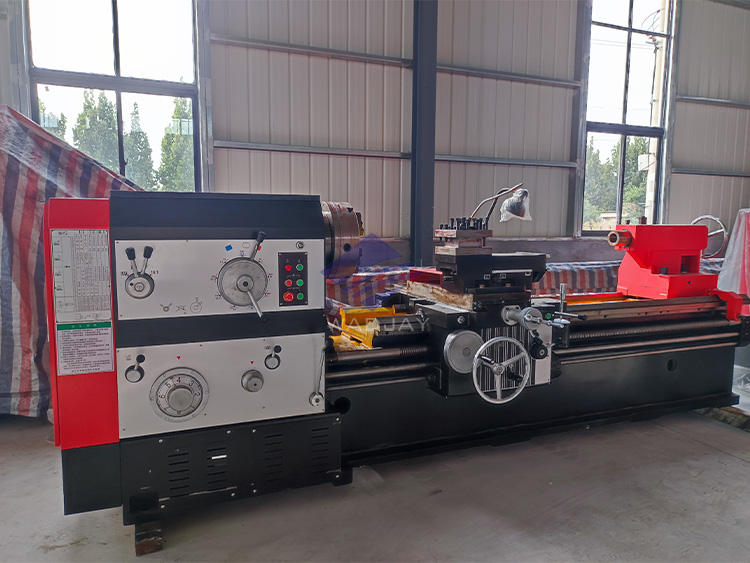
Long-Bed Options (1500 / 2000 / 3000mm)
- 1500mm bed → flanges, short shaft couplings, repair spools
- 2000mm bed → standard reducer shaft, pump shaft
- 3000mm bed → long drive shaft, roller, mandrel, marine prop shaft class
Tailstock quill travel 300mm + cross slide 420mm → you can support long work between centers anddo face + bore + drill on the chuck end. One setup covers most heavy-shaft workflows.
What CW6180 Machines Well (Workpiece List)
| Workpiece | Why CW6180 Fits |
|---|---|
| Long shafts (reducer, pump, fan, crusher) | 800mm swing + 3000mm bed, between-centers + steady rest |
| Heavy-wall pipes / spools (oil & gas) | 11/15kW roughing, 10rpm low-end for big Ø |
| Flanges (blind / WN / SO, up to 800mm OD) | Face + bore + drill/tap, 4-jaw independent chuck standard |
| Roller bodies / mandrels | Cast iron bed damp vibration, finish pass Ra achievable |
| Gear blanks (large Ø) | Rough + finish in one chucking if Ø ≤ 800 |
| Coupling hubs / spacers | Short heavy, chuck work, cross slide 420mm reach |
| Repair & rework (worn shaft O/D build-up + re-turn) | Manual control = easy to “feel” the cut on a repaired part |
Conventional (Manual) vs CNC Slant-Bed — Honest Buying Split
| Factor | CW6180 Conventional Heavy Lathe | CNC Slant-Bed (OKUMA/DOOSAN class) |
|---|---|---|
| Workpiece size | Ø up to 800, L up to 3000 | Usually Ø ≤ 500–650 on slant-bed |
| Batch size | Low-mix, one-off, repair, heavy | High-mix-high-repeat, tight tolerance |
| Operator | Traditional turner (reads dial) | CNC programmer / setter |
| Complexity | Manual handwheel, mechanical gear | G-code, ATC, live tooling optional |
| On-site repair | Gearbox field-repairable | Electronics-dependent |
| Price point | Fraction of CNC | 5–15× |
| Best fit | Heavy machinery, oil & gas repair, power plant maintenance, job-shop “big stuff” | Production batch prismatic, automotive, aerospace |
Industries & Typical Deployments
⚙️ Heavy Machinery Manufacturing
- Reducer housings (mate with gear hobber/shaper — our YB6212 / YK5132CNC / YK3180CNC4 line) → shaft turned on CW6180, gear cut next door
- Crusher / conveyor drive shafts
- Fan & blower rotor shafts
🛢️ Oil & Gas Equipment
- Valve body flanges (face + bore + drill bolt circle)
- Spool adapters, casing collars
- Repair & rework of worn shaft O/D (build-up weld + re-turn)
⚡ Power Equipment
- Turbine auxiliary shafts (small hydro / thermal aux)
- Generator coupling hubs
- Maintenance bay: rotor journal rework
🔧 Repair & Maintenance (Captive Plants)
- Cement, sugar, textile, paper mill — captive maintenance bays love an 800mm conventional:
- Crane + lathe + welded repair corner = self-sufficient plant maintenance
- Mechanical gearbox = local mechanic can keep it alive 20 years
tandard Configuration & Common Add-Ons
Base machine includes:
- 3-jaw chuck (or 4-jaw independent, preferred for flanges)
- 12-speed mechanical gearbox (10–1000rpm)
- Tailstock with quill (300mm travel)
- Steady rest (basic, for long shaft between centers)
- Follow rest (optional)
- Coolant pump & tray
- 11kW or 15kW main motor (regional voltage configurable)
Common add-ons for CW6180 buyers:
- 4-jaw independent chuck (flange work — must-have)
- Faceplate (irregular heavy forgings)
- Second steady rest (very long shaft, double-support)
- Taper attachment (long taper turning without offset tailstock hack)
- Quick-change tool post (AXA/BXA size, speeds setup vs standard 4-way tool post)
- Chuck guard / splash guard (CE compliance for export)
Operation & Maintenance – Shop-Floor Notes
- Lubrication: manual oil cups on carriage + saddle, gearbox oil bath — check monthly on 2-shift
- Bed ways: keep chips off, wipe & re-oil daily — cast iron ways hold accuracy years if cared for
- Spindle: check bearing temp after heavy roughing sessions; 15kW pushes heat into headstock
- Tailstock: quill 300mm — lock quill before cut, especially on off-center facing
- Gearbox: if shifting feels “notchy” under load, stop and check clutch/gear engagement — mechanical gearbox talks to you before it breaks, listen
CW6180 vs “Just Buy a Bigger CNC” — The Cost Logic
Illustrative (your local market will differ):
| Cost Item | CW6180 Conventional | CNC Slant-Bed 800mm-class (if you can even find one) |
|---|---|---|
| Machine price | $X (factory direct) | 5–10× |
| Operator | Traditional turner | CNC programmer |
| Foundation | Standard bay, no pit | Often pit + heavier foundation |
| Repair | Gearbox parts local | Electronics / OEM only |
| Break-even | Fast on low-mix | Slow unless high batch |
FAQ
Q: What’s the difference between “heavy duty horizontal lathe” and a “CNC lathe”?
A: Heavy duty horizontal lathe (CW6180 class) is flat-bed, manual/mechanical, built for large swing + long bed + heavy roughing — think shafts, flanges, pipes. CNC lathes are usually slant-bed, G-code, ATC, built for repeat batch + contour. They serve different work: CW6180 = big/heavy/one-off/repair; CNC = repeat/tight/contour.
Q: Can CW6180 handle both steel and cast iron?
A: Yes — 11/15kW + 10rpm low end takes heavy roughing cuts on steel; cast iron faces fine at mid rpm. Insert selection (CNMG / DCMT etc.) is the operator’s call per material.
Q: What bed length should I choose?
A: 1500mm → flanges, short couplings. 2000mm → standard pump/reducer shaft. 3000mm → long drive shaft, roller. If you’re unsure, 2000mm is the “safe middle” for most heavy shops; 3000mm if you see roller/mandrel work coming.
Q: Is it CE/ISO?
A: Yes — CW6180 is CE / ISO certified, with customizable voltage (380V/50, 415V/50, 440V/60…) and full export docs.
Q: What chuck comes standard?
A: Typically 3-jaw scroll for shaft work; we recommend adding a 4-jaw independent if you’re doing flanges (you will want it). Faceplate optional for irregular forgings.
Q: What do you need to quote?
A: (1) Bed length (1500/2000/3000 or custom) — (2) Motor 11kW or 15kW — (3) Chuck preference (3-jaw / 4-jaw / faceplate) — (4) Voltage — (5) Typical workpieces (shaft? flange? pipe?)
-300x300.png)